Bug 2231180
| Summary: | webUI could discover storage issues earlier: no BIOS boot partition, not enough partitions... | ||
|---|---|---|---|
| Product: | [Fedora] Fedora | Reporter: | Adam Williamson <awilliam> |
| Component: | anaconda-webui | Assignee: | Katerina Koukiou <kkoukiou> |
| Status: | CLOSED ERRATA | QA Contact: | |
| Severity: | medium | Docs Contact: | |
| Priority: | unspecified | ||
| Version: | 39 | CC: | anaconda-maint, jkonecny, kkoukiou, mkolman, rvykydal, vslavik, w |
| Target Milestone: | --- | ||
| Target Release: | --- | ||
| Hardware: | All | ||
| OS: | Linux | ||
| Whiteboard: | |||
| Fixed In Version: | Doc Type: | If docs needed, set a value | |
| Doc Text: | Story Points: | --- | |
| Clone Of: | Environment: | ||
| Last Closed: | 2024-11-08 16:55:02 UTC | Type: | --- |
| Regression: | --- | Mount Type: | --- |
| Documentation: | --- | CRM: | |
| Verified Versions: | Category: | --- | |
| oVirt Team: | --- | RHEL 7.3 requirements from Atomic Host: | |
| Cloudforms Team: | --- | Target Upstream Version: | |
| Embargoed: | |||
| Bug Depends On: | |||
| Bug Blocks: | 2231339 | ||
|
Description
Adam Williamson
2023-08-10 21:13:43 UTC
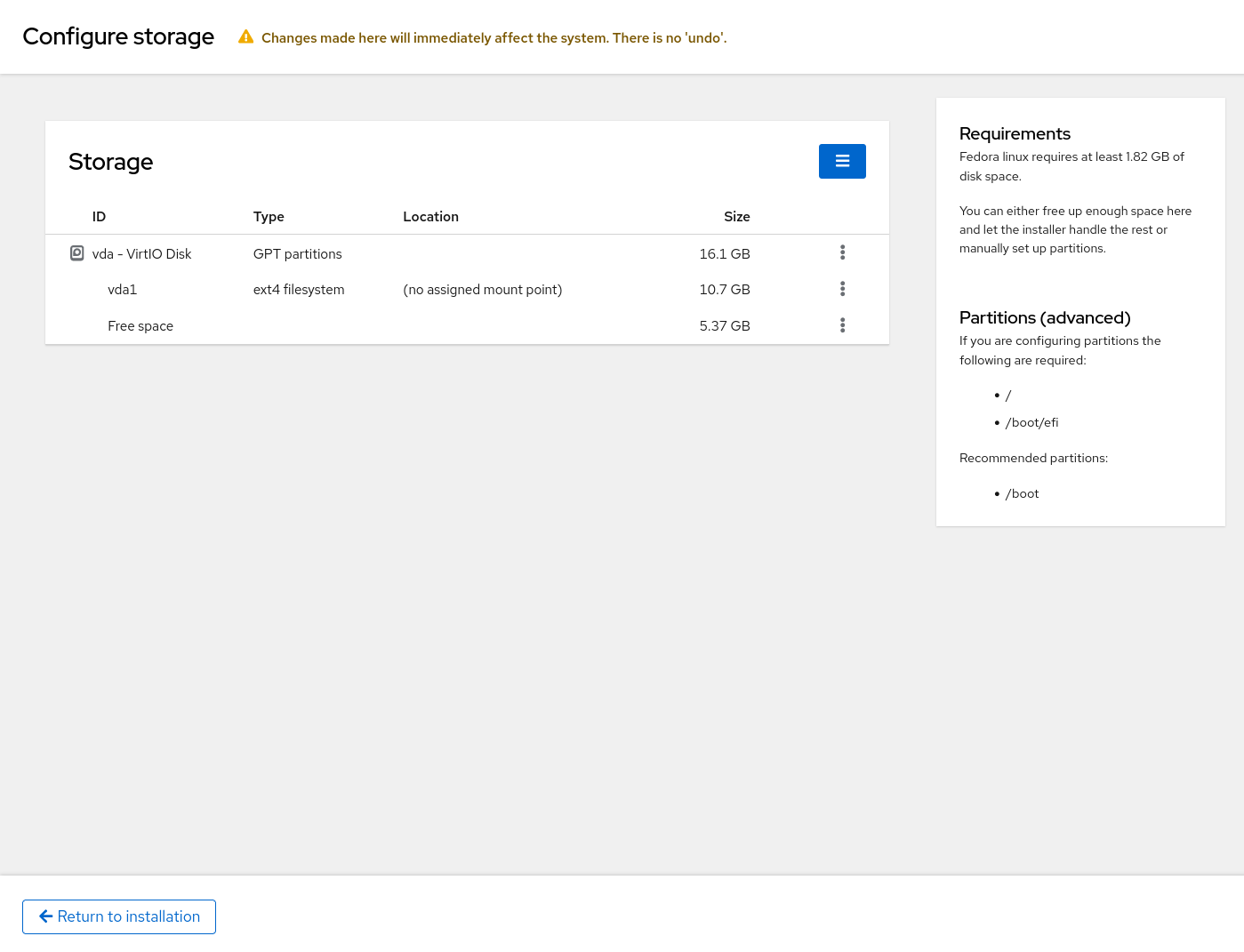
See also https://bugzilla.redhat.com/show_bug.cgi?id=2231182 - blivet-gui on the Workstation live cannot actually create a BIOS Boot partition at all, so you cannot create an installable layout on a BIOS system using pre-installed GUI tools. (In reply to Adam Williamson from comment #0) > I had a play around with the web UI interface today, particularly the > storage part. One thing I notice: it could be much smarter about detecting > storage problems. > > 1. It will let you into the "Mount point assignment" screen even if you have > only *one* partition, but it is impossible to complete an install with one > partition. It *knows* two are required - the UI lists /boot and / as > "required" - so why let you into the screen at all? It could check that > there are *enough* formatted partitions, not just *at least one* formatted > partition. This will get mitigated by making /boot partition only recommended (https://github.com/rhinstaller/anaconda-webui/pull/95) at least in case of biosboot where only single partition (for /) is required (leaving aside a a special check for biosboot partition - the issue 2. below). But for efi we still require 2 partitions. We should be able to add some earlier check. Also, the integrated blivet-storage screen that should replace blivet-gui (https://github.com/rhinstaller/anaconda-webui/pull/72) will present hints about required partitions, so this will also help to have everything ready before going to Mount point assignment. But we still want the early check for example for the partitions created via terminal. > 2. It only tells you about missing non-mounted partitions very late. e.g. if > you don't have a BIOS boot partition, you cannot complete a BIOS install, > but the installer will let you go through "Mount point assignment" and > assign your /boot and / partitions, *then* it tells you that you need a BIOS > boot partition. It could warn you about this much earlier, either as soon as > you enter the "Mount point assignment" screen, or by greying that option out > with an explanation as it does if you don't have any partitions. The latter should be doable, we need to propagate the requirement/constraint from Anaconda: https://github.com/rhinstaller/anaconda/pull/5425 https://github.com/rhinstaller/anaconda-webui/pull/140 (In reply to Radek Vykydal from comment #2) > (In reply to Adam Williamson from comment #0) > > I had a play around with the web UI interface today, particularly the > > storage part. One thing I notice: it could be much smarter about detecting > > storage problems. > > > > 1. It will let you into the "Mount point assignment" screen even if you have > > only *one* partition, but it is impossible to complete an install with one > > partition. It *knows* two are required - the UI lists /boot and / as > > "required" - so why let you into the screen at all? It could check that > > there are *enough* formatted partitions, not just *at least one* formatted > > partition. > > This will get mitigated by making /boot partition only recommended > (https://github.com/rhinstaller/anaconda-webui/pull/95) at least in case of > biosboot where only single partition (for /) is required (leaving aside a a > special check for biosboot partition - the issue 2. below). But for efi we > still require 2 partitions. We should be able to add some earlier check. > Also, the integrated blivet-storage screen that should replace blivet-gui > (https://github.com/rhinstaller/anaconda-webui/pull/72) will present hints > about required partitions, so this will also help to have everything ready > before going to Mount point assignment. But we still want the early check > for example for the partitions created via terminal. Thinking of it more, maybe having an early warning for not enough usable devices before entering the screen is not so good idea. To inform the user which mount points are required (eg /, /boot/efi) we need either let him enter the screen where it is pretty visible (as a list of prefiled mount point assignments) and go back (which is not so bad experience I think), or present the information already on the method selection screen which is not very suitable for that I think [1]. Combined with the information present in cockpit-storage UI (replacement of python-blivet), preview here: https://rvykydal.fedorapeople.org/webui/cockpit-storage/cockpit-storage-hint-preview.png, I am inclined to leave the UI as is in this aspect (1.) and focus on the issue 2. [1] Maybe by a message like "Not enough usable devices on the selected disks for the required partitions (/boot/efi, /) This could handle even biosboot case: "Not enough usable devices on the selected disks for the required partitions (biosboot, /)". The message can be certainly improved but I still don't like the approach compared to what user sees in the assignment screen. This message is a reminder that Fedora Linux 39 is nearing its end of life. Fedora will stop maintaining and issuing updates for Fedora Linux 39 on 2024-11-26. It is Fedora's policy to close all bug reports from releases that are no longer maintained. At that time this bug will be closed as EOL if it remains open with a 'version' of '39'. Package Maintainer: If you wish for this bug to remain open because you plan to fix it in a currently maintained version, change the 'version' to a later Fedora Linux version. Note that the version field may be hidden. Click the "Show advanced fields" button if you do not see it. Thank you for reporting this issue and we are sorry that we were not able to fix it before Fedora Linux 39 is end of life. If you would still like to see this bug fixed and are able to reproduce it against a later version of Fedora Linux, you are encouraged to change the 'version' to a later version prior to this bug being closed. well, the PR intended to fix this got merged, so let's call it fixed. I'll try and see what the state of this is with current web UI later. |