Note: This bug is displayed in read-only format because
the product is no longer active in Red Hat Bugzilla.
RHEL Engineering is moving the tracking of its product development work on RHEL 6 through RHEL 9 to Red Hat Jira (issues.redhat.com). If you're a Red Hat customer, please continue to file support cases via the Red Hat customer portal. If you're not, please head to the "RHEL project" in Red Hat Jira and file new tickets here. Individual Bugzilla bugs in the statuses "NEW", "ASSIGNED", and "POST" are being migrated throughout September 2023. Bugs of Red Hat partners with an assigned Engineering Partner Manager (EPM) are migrated in late September as per pre-agreed dates. Bugs against components "kernel", "kernel-rt", and "kpatch" are only migrated if still in "NEW" or "ASSIGNED". If you cannot log in to RH Jira, please consult article #7032570. That failing, please send an e-mail to the RH Jira admins at rh-issues@redhat.com to troubleshoot your issue as a user management inquiry. The email creates a ServiceNow ticket with Red Hat. Individual Bugzilla bugs that are migrated will be moved to status "CLOSED", resolution "MIGRATED", and set with "MigratedToJIRA" in "Keywords". The link to the successor Jira issue will be found under "Links", have a little "two-footprint" icon next to it, and direct you to the "RHEL project" in Red Hat Jira (issue links are of type "https://issues.redhat.com/browse/RHEL-XXXX", where "X" is a digit). This same link will be available in a blue banner at the top of the page informing you that that bug has been migrated.
.User Creation screen is unresponsive in Japanese
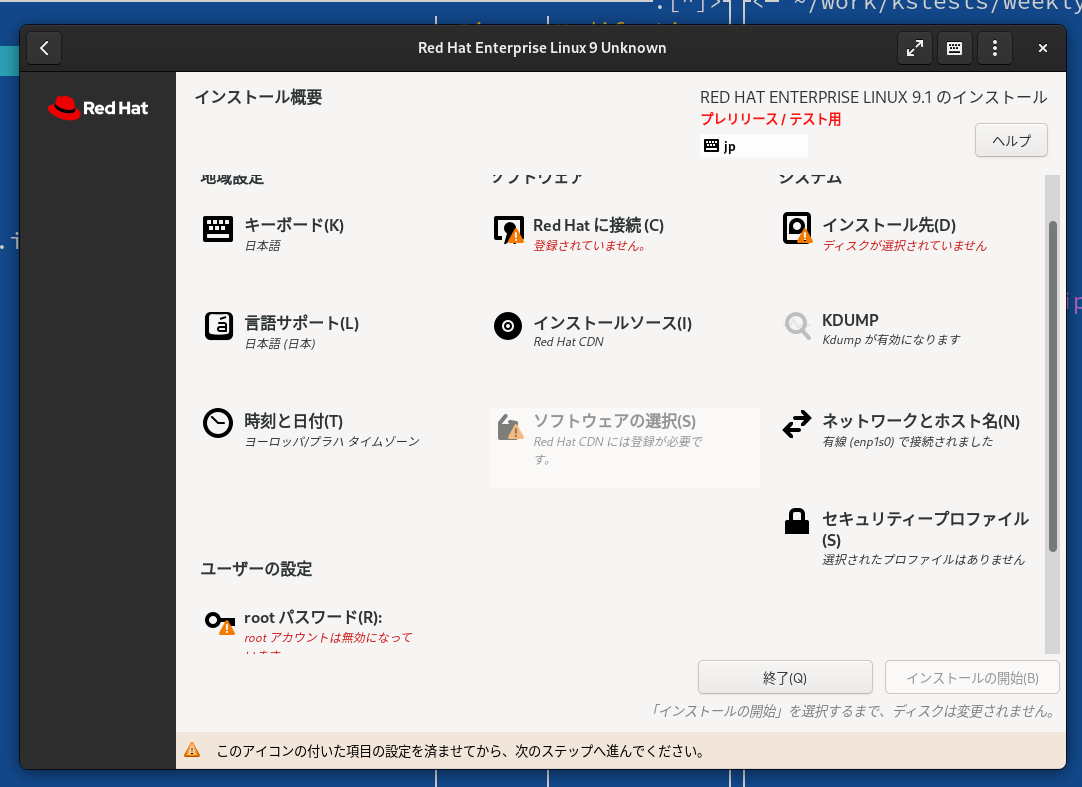
When installing RHEL with the Japanese language and using a graphical user interface, the User Creation screen is unresponsive. As a consequence, creating users during installation is more difficult.
To work around this problem, use one of the following solutions to create users:
* Access the User Creation dialogue by using keyboard shortcuts (press `Alt+U` and then `Enter`).
* Run the installation in VNC mode and resize the VNC window.
* Create users after completing the installation process.
Description of problem:
Sometimes it's not possible to scroll the main hub screen if all the items do not fit on the screen.

This is a problem for example when running the installation process in Japanese and the screen resolution is set to 1024x768 (the default resolution in KVM or when running the installation via VNC). In such a case the "User Creation" button is not visible and it's not possible to scroll to show it.

It can be reproduced in English as well - run the installation in VNC mode (use "inst.vnc" on the kernel command line), connect to the started vnc server and resize the vnc window after entering the main hub. At some point the "User Creation" button is (partially) hidden, the scroll bar is visible, but it's not possible to use it. It's also not possible to use the key arrows/mouse wheel to scroll down.

Version-Release number of selected component (if applicable):
RHEL-9.1.0-20220819.0
anaconda-34.25.1.11-1.el9
gtk2-2.24.33-7.el9

How reproducible:
always

Steps to Reproduce:
1. Run the installation in KVM/via VNC and select Japanese as the installation language. OR
1. Run the installation with "inst.vnc" on the kernel cmdline and resize the vnc window after entering the main hub. Some screen sizes do not allow to scroll the screen (some screen sizes work just fine).

Actual results:
Unable to scroll to create a user account.

Expected results:
All items on the main hub fit on the screen, or the user is able to scroll on the main hub to reach the hidden ones.

Additional info:
This problem can also be reproduced on RHEL-9.0 GA via VNC, but it is not a problem for the main hub in Japanese, since all items fit on the screen in the RHEL-9.0 installer. It could be caused partially due to the missing "pre-release" warning in GA version of the installer, due to slightly different padding and/or due to new translation of the "Security Profile" spoke.
From a quick, the status label in https://github.com/rhinstaller/anaconda/blob/rhel-9/widgets/src/SpokeSelector.c#L301 does not call gtk_label_set_line_wrap() (the title label does), and I remember there being some weirdness in GTK4 associated with that combination. I can't find the upstream issue where this was discussed though, so no more details for now.

But could you try adding a call to gtk_label_set_line_wrap(GTK_LABEL(spoke->priv->status_label), TRUE); and see if that helps?
I think we can accept the solution / workaround from comment #12 for this release. It seems to actually improve the layout for Japanese language and not to break it for other languages.

I'll clone the BZ for Gtk so that the issue with scrollbar can be investigated / fixed eventually if needed.
Tested all these supported languages and all elements on the main hub are now visible on the default-sized screen (1024x768): English, French, German, Italian, Russian, Spanish, Portuguese, Chinese, Japanese, Korean

Tested with anaconda-34.25.1.13-1.el9, marking as Verified:Tested.
Since the problem described in this bug report should be
resolved in a recent advisory, it has been closed with a
resolution of ERRATA.

For information on the advisory (anaconda bug fix and enhancement update), and where to find the updated
files, follow the link below.

If the solution does not work for you, open a new bug report.

https://access.redhat.com/errata/RHBA-2022:7977